
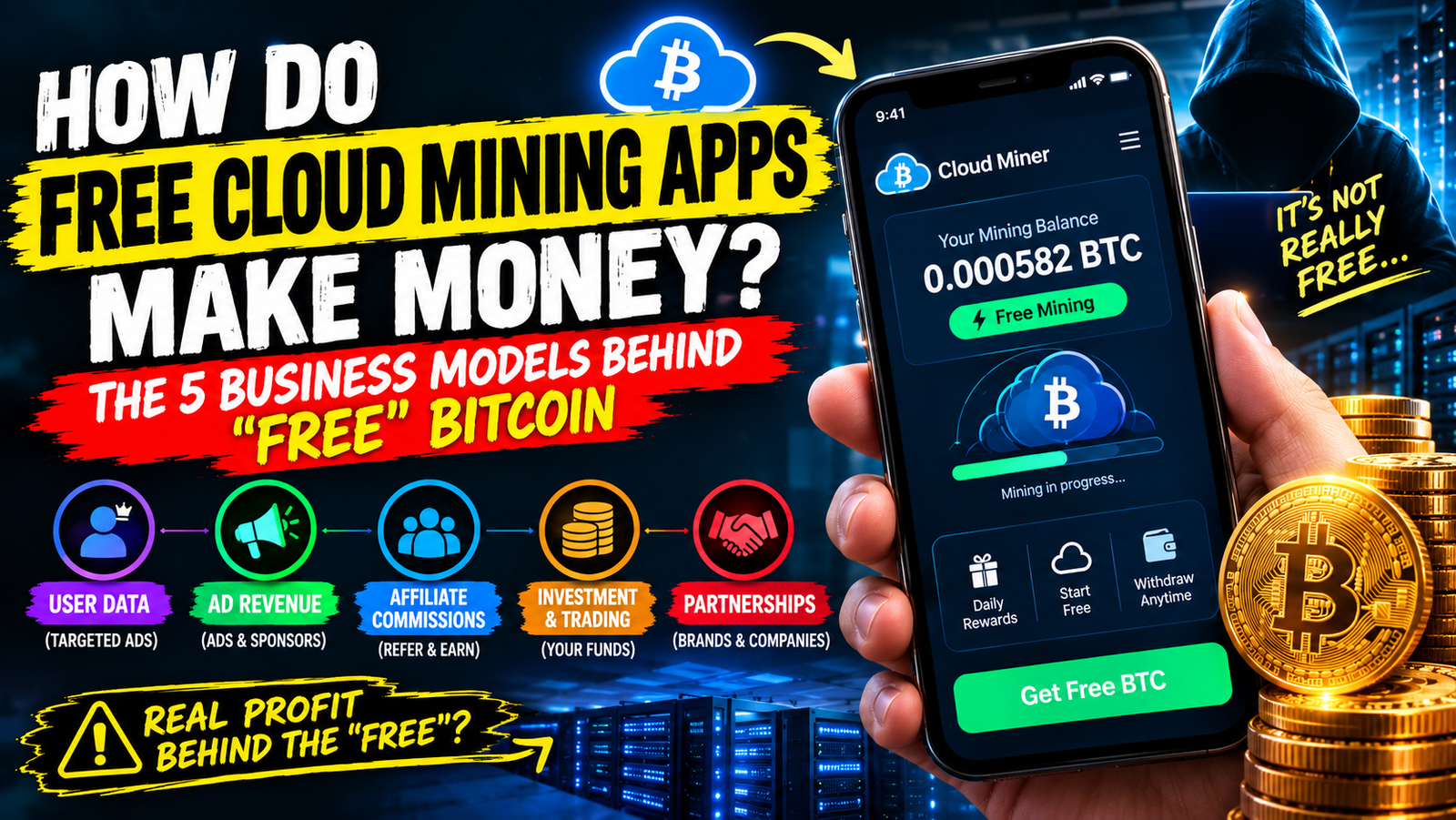
Let’s run a little thought experiment. Somewhere, a team of developers built a slick app, rented servers, paid for an ad campaign that put it on your phone at 11 p.m., and now gives you Bitcoin for free. Who’s paying for all of that?
If the answer isn’t obvious, here’s the uncomfortable rule I want you to keep for the rest of this site: “free” never means nobody pays. It means you’re not the one being shown the bill yet.
Hi, friend, glad you’re here. Today we’re following the money behind free cloud mining apps. By the end, you’ll be able to open any of them, look for five specific clues, and know within a couple of minutes how it really earns its living. Let’s go.
In This Guide
- The Short Answer
- Model 1: Your Attention (Ads)
- Model 2: Your Wallet (Upgrades and Subscriptions)
- Model 3: Your Data
- Model 4: Your Friends (Referrals)
- Model 5: Other People’s Deposits
- How to Spot Which Model You’re Looking At
- Two 60-Second Tests
- Is It Always Bad?
- Frequently Asked Questions
The Short Answer
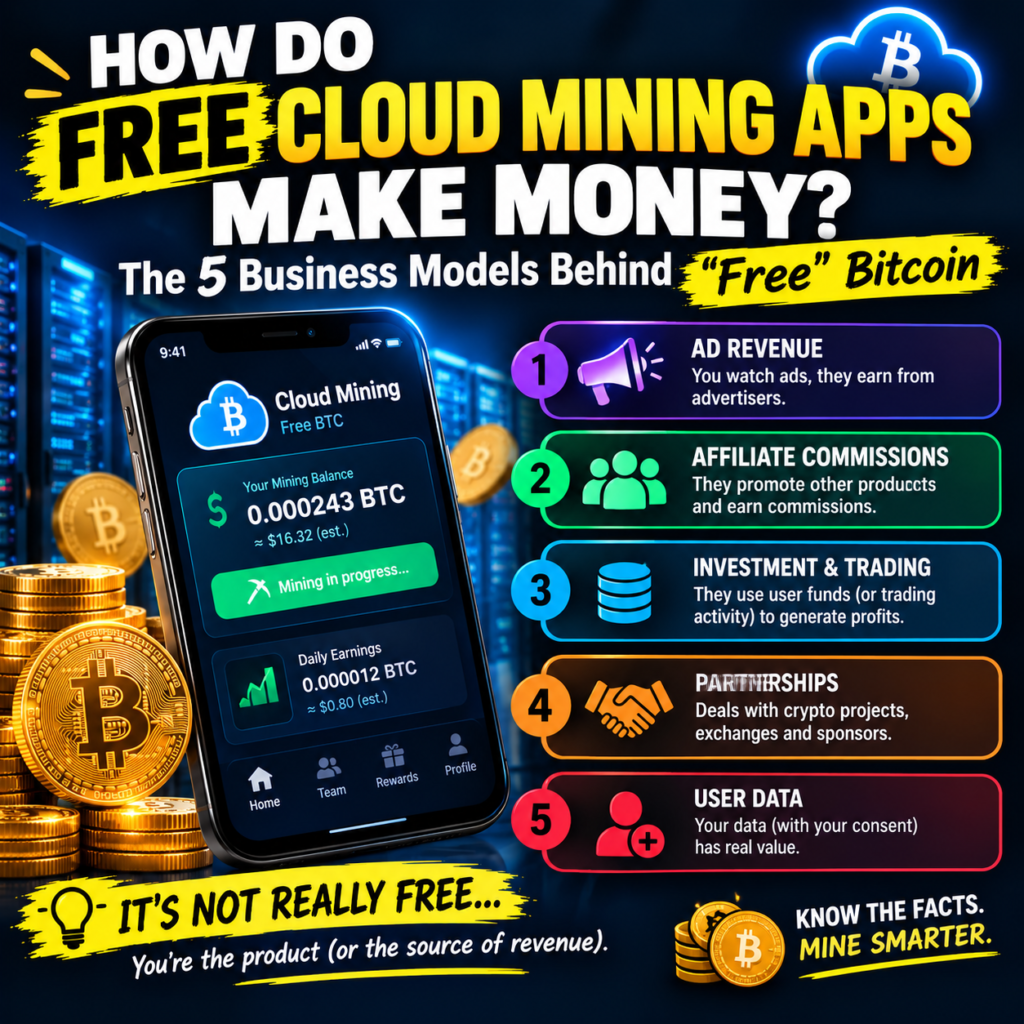
Free cloud mining apps usually make money in one or more of five ways: ads, paid upgrades, your data, referrals, or other users’ deposits. Actual Bitcoin mining profit is rarely on the list. That’s not a guess. Security researchers have taken these apps apart, and I’ll show you what they found.
Model 1: Your Attention (Ads)
This is the most common one. In 2021, security firm Trend Micro analyzed a batch of cloud mining apps on Google Play and found that they had no cryptocurrency mining behavior at all. Instead, some told users they could start mining only after watching video ads, or that watching more ads would increase their mining speed. Trend Micro’s own blog summarized it plainly: almost all of these apps use ads to generate revenue.
Their data suggested more than 120 such apps were still in use, and that they had affected more than 4,500 users worldwide between July 2020 and July 2021 (Trend Micro’s research). That research is a few years old, but the same pattern shows up today: one app’s own store page now says your “mining progress” represents rewards for completing tasks sponsored by advertisers. In other words, the ad is the product.
Model 2: Your Wallet (Upgrades and Subscriptions)
The free tier is the bait, and the “boost” is the hook. Trend Micro found apps that pushed in-app purchases for “increased mining capabilities” ranging from $14.99 to as much as $189.99. Others charged monthly subscriptions, which news coverage of the research put at an average of around $15 a month.
Here’s the part that stunned me: the researchers described the on-screen mining as a local simulation module with a counter and some random functions. The number going up is just a number going up. Pay for an upgrade and the counter simply goes up faster.
Model 3: Your Data
Some apps earn from what they learn about you. On Google Play, every app has a “Data safety” section where the developer must declare what it collects and shares. In the listing for one cloud mining app I reviewed, the declaration said it may collect and share location and financial information with third parties and that the data can’t be deleted. You can read how I handled that in my Rise Miner review.
I’m not saying every app that collects data is selling it. I’m saying a mining dashboard has no obvious reason to need your financial information, so when it asks, ask why.
Model 4: Your Friends (Referrals)
“Invite friends to mine faster.” Reports on the Trend Micro research noted that some apps promised better mining capabilities and revenue for inviting friends. Each invite can earn the app a new user to show ads to, and sometimes a new customer for upgrades. You become the marketing department, unpaid.
Model 5: Other People’s Deposits
This is the dangerous one. Securities regulators have described a pattern in cloud mining schemes: an upfront payment, promised daily or weekly payouts as a percentage of what you put in, and affiliate commissions for recruiting. In some warnings, regulators compared the structure to a Ponzi scheme, where new users’ money pays earlier users until the flow stops. If an app checks all three boxes, it’s not a mining business, whatever the logo looks like. I explain how to vet this in how to check whether a mining company is legit.
And what about real cloud mining? It does exist. Real providers earn from the gap between what they charge for a contract and what the hardware costs to run, plus maintenance and electricity fees. But that business is never “free”: you pay for the hash power. A free app claiming the same economics should make you ask where the money comes from.
How to Spot Which Model You’re Looking At
| What you see | Likely model | What I’d do |
|---|---|---|
| “Watch an ad to start mining” | Ads | Treat it as a rewards app, not mining |
| “Boost” or “upgrade” buttons with prices | Upgrades | Don’t pay until a withdrawal works |
| Data safety lists location or financial data | Data | Skip, or deny every permission |
| “Invite friends for more power” | Referrals | Don’t recruit friends into it |
| Daily percentage returns on a deposit | Deposits | Stay away, and see my red flags guide |
| Contract price, hardware details, fees disclosed | Real cloud mining (maybe) | Verify before paying anything |
Two 60-Second Tests
Trend Micro’s researchers suggested two simple checks you can run yourself. Neither is proof, but a fail is a loud warning:
- The wrong-wallet test. Enter an obviously invalid wallet address when you set up payouts. A real service has to validate where your money goes. A fake app that never intends to pay doesn’t care, so it accepts anything.
- The restart test. Close the app or restart your phone while it’s “mining,” then reopen it. If the coin counter resets to zero or jumps oddly, the number was never connected to real mining.
Passing both doesn’t prove an app is honest, and failing doesn’t tell you the app is malicious in every way. But if an app fails, you’ve learned what it is.
Is It Always Bad?
Fair question. An ad-supported rewards app isn’t automatically a scam. If it says clearly, “watch ads, collect small rewards,” and pays what it promises, that’s just an honest, tiny-paying app. The problem starts when the pitch is “Bitcoin mining” while the business is ads, upgrades, or deposits. Honest labeling is the line between a harmless app and a misleading one.
If you want the bigger picture, my guides on free cloud mining sites and mining on your phone show the math behind why these apps can’t pay much, and my fake mining app checklist covers more red flags.
Frequently Asked Questions
How do free cloud mining apps make money?
Mostly through ads, paid upgrades and subscriptions, data collection, referral programs, and in the worst cases, other users’ deposits. Security research has found many such apps contain no real mining at all.
Are free cloud mining apps real?
Some offer a tiny amount of real hash power as a trial, but many are ad-driven reward apps or simulations. The only proof is a withdrawal that actually arrives, and even then the amounts are typically very small.
Do cloud mining apps sell your data?
Some declare that they collect and share data with third parties. Check the “Data safety” section on Google Play or the privacy details on the App Store before installing, and be wary of apps that ask for financial information.
Why do cloud mining apps ask me to watch ads?
Because the ads are how the app earns money. Watching them doesn’t mine anything. It generates ad revenue for the developer.
Should I pay for a mining upgrade?
I wouldn’t until a small withdrawal has already reached your wallet. Researchers have found fake apps selling upgrades that did nothing but speed up an on-screen counter.
Before you close this tab, here’s a two-minute homework assignment. Open one cloud mining app you’ve been curious about. Find its “Data safety” section and its terms of use, and write down in one sentence who you think is paying for it. If you can’t answer, you’ve just learned something important. Drop what you found in the comments, because I read them all, and share this with a friend who’s been tempted by a “free Bitcoin” ad. Follow the money, always. 💸
Disclosure: This article draws on published security research (Trend Micro, 2021) and regulator warnings, plus my own review of public app store listings. I have not tested the apps mentioned beyond what is described, and I have no affiliate relationship with any app or platform. It is for information only and is not financial advice.
Related: Spot fake mining apps · Rise Miner review · Cloud mining reviews