Imagine a stranger walks up, hands you a glossy brochure, and says, “Give me $500 and I’ll send you a little money every day.” You wouldn’t hand it over. You’d ask who they are, where they work, and why you should believe them. Funny thing is, when the same pitch arrives on a slick website with a mining photo and a countdown timer, a lot of us skip every one of those questions.
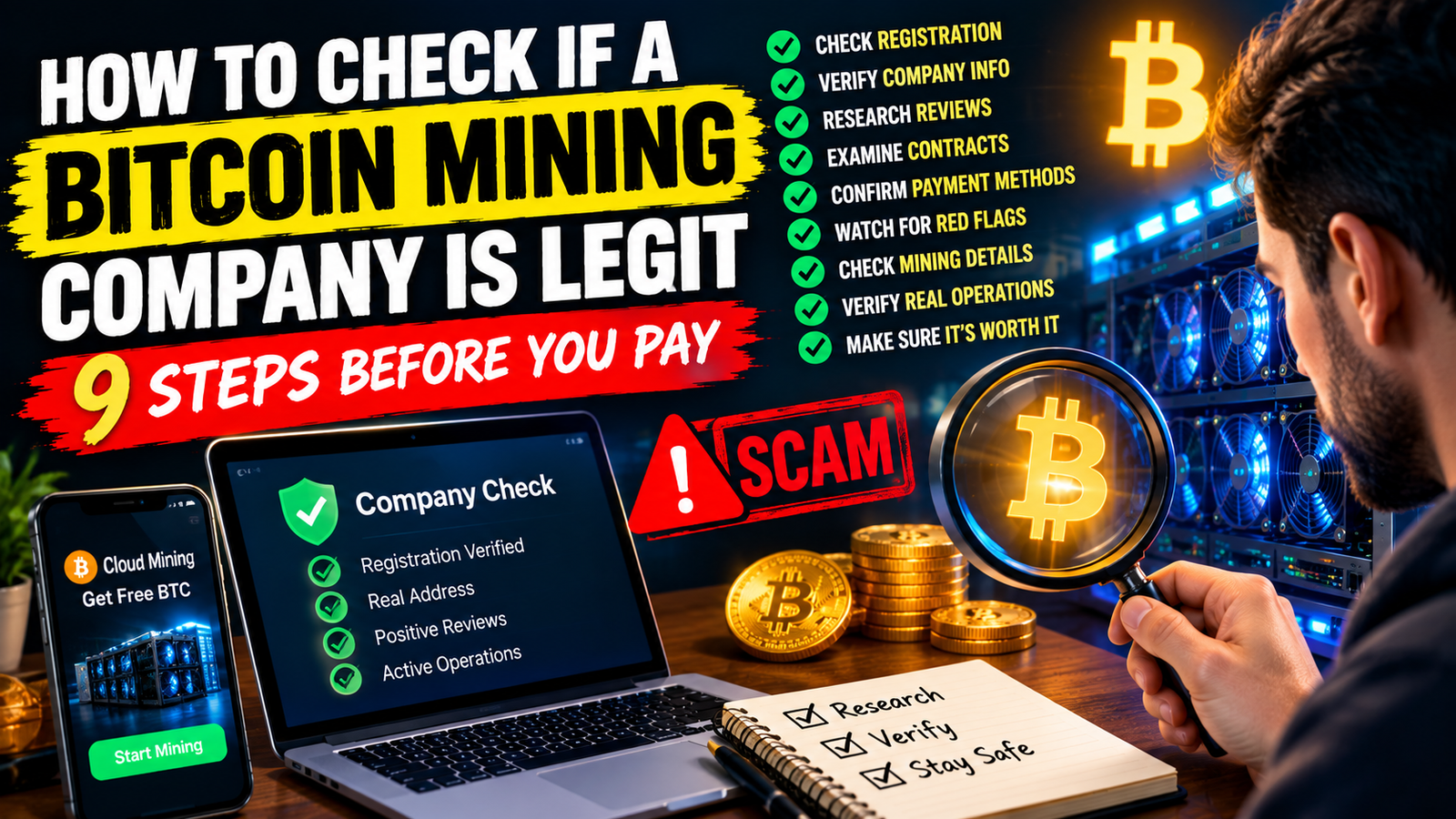
Hi friends, good to see you. Today I’m giving you the nine questions I’d ask before putting a single dollar into any Bitcoin mining company or cloud mining platform. They take about 20 minutes, they’re free, and they cover the mistakes that cost people the most. Let’s get into it.
In This Guide
- The Pattern Regulators Warn About
- The 9 Steps
- A Quick Scorecard
- What to Do If It Fails a Check
- Frequently Asked Questions
The Pattern Regulators Warn About
Securities regulators in several countries have published warnings about cloud mining schemes, and the pattern they describe is surprisingly consistent. The Philippine SEC, for example, said such companies typically do three things:
- They require an upfront fee or investment, in cash or crypto, to get a mining contract.
- They promise daily or weekly payouts, usually as a percentage of what you paid in.
- They pay affiliate commissions for every person you recruit.
If a site checks all three boxes, treat it as high risk before you even start the nine steps below. In some regulator warnings, similar schemes were described as Ponzi-style, where new deposits fund payouts to earlier users.
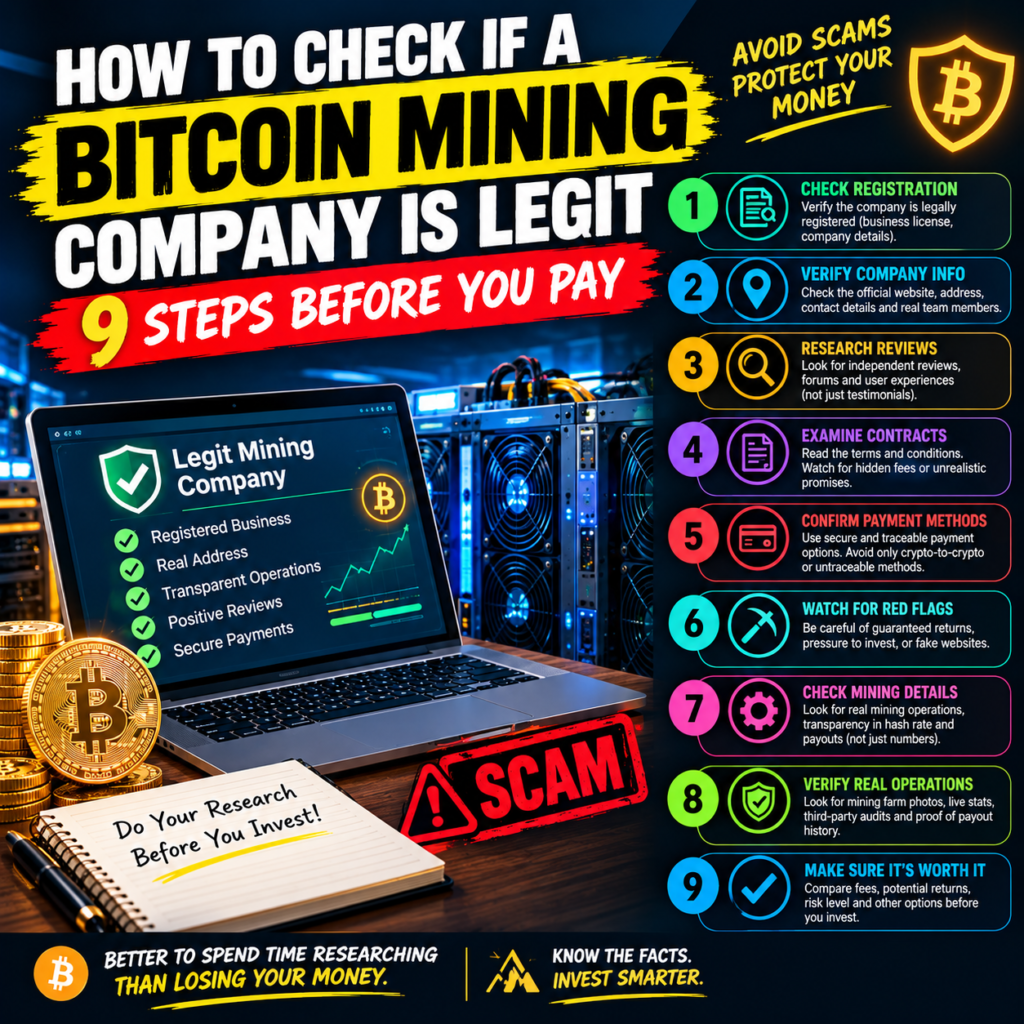
The 9 Steps
1. Find out who actually owns it
Look for a legal company name, a street address, and named leaders with real, checkable histories. If the “About” page is vague, or the company name changes from page to page, that’s a problem.
2. Verify the company is registered
For a US company, search your state’s Secretary of State business registry. Registration alone proves very little, since anyone can register a company, but a company that claims to be registered and isn’t has told you something important.
3. Check regulator warning lists
The SEC keeps public alerts about unregistered soliciting entities, including cloud mining names. Your state securities regulator may have warnings too, and the North American Securities Administrators Association can point you to it. Outside the US, check your own country’s financial regulator.
4. Look at the website’s age
A free “WHOIS” lookup shows when a domain was created. A site that’s a few weeks old and promises years of stable returns deserves extra suspicion. Hidden ownership alone isn’t a smoking gun, but it adds to the pile.
5. Ask for proof of real mining
A real operation can show where its machines are, who hosts them, and how much hashrate it actually runs. Ask whether the company publishes pool statistics or an observer link you can check independently. If it can’t prove it’s mining, it probably isn’t.
6. Read the contract like a skeptic
Honest providers explain contract length, maintenance and electricity fees, and what happens when mining becomes unprofitable. They admit that returns can be low or even negative. A contract that promises fixed daily profits with no risk language is the opposite of honest.
7. Notice how they want to be paid
Crypto-only payments, gift cards, or pressure to move the conversation to a private chat app are red flags. They make your money hard to recover.
8. Read the bad reviews first
Sort reviews by lowest rating and look for patterns, like withdrawals that never arrive or support that vanishes. Be wary of a wall of five-star reviews that all sound the same. Search “[company name] withdrawal” and “[company name] scam” too.
9. Run a tiny test, and test the exit first
If everything else checks out, start with an amount you could lose without flinching, and try a small withdrawal early. The point isn’t to earn. The point is to prove money can leave. Never add more until it does.
A Quick Scorecard
| Check | Green | Red |
|---|---|---|
| Ownership | Named company and leaders | Anonymous or inconsistent |
| Regulator lists | No warnings found | Named in an alert |
| Proof of mining | Verifiable hashrate and facilities | None offered |
| Returns | Variable, risks explained | Fixed daily percentage |
| Recruiting | No referral commissions | Affiliate payouts for signups |
| Withdrawals | Small test succeeds | Fees, delays, excuses |
Rule of thumb: two or more reds, walk away. One red means dig deeper before you commit.
What to Do If It Fails a Check
Walk away, and consider reporting it. In the US you can file at ReportFraud.ftc.gov. If you’ve already sent money, read what to do when a cloud mining balance is stuck on pending. And for apps instead of companies, my guide to spotting fake Bitcoin mining apps has a matching checklist.
Frequently Asked Questions
How can I tell if a cloud mining company is legit?
Check who owns it, whether regulators have warned about it, whether it can prove real mining, and whether a small withdrawal actually works. No single check is proof, but failing several is a strong warning.
Is cloud mining legal in the US?
Cloud mining contracts can raise securities-law questions, and rules vary. That’s one reason to check regulator warnings and consider talking to a qualified professional before putting in meaningful money.
Does a company registration mean it’s trustworthy?
No. Registration is easy and doesn’t prove the company mines or pays out. It only helps you confirm the company is who it claims to be.
What if the company has great reviews?
Read the lowest-rated ones too, and look for withdrawal complaints. Reviews can be manipulated, so use them as one signal among many.
Do me one favor: screenshot the scorecard above and keep it on your phone. The next time a “mining opportunity” lands in your inbox, you’ll have your checklist ready in seconds. And I’m curious: which step would have saved you, or someone you know, the most? Tell me in the comments, and share this with anyone who’s ever said “it looked so professional.” Trust, but verify. 🔍
Disclosure: This guide is general educational information drawn from public regulator warnings and scam-awareness resources. It is not legal or financial advice, and no checklist can guarantee a company is safe. I have no affiliate relationship with any company mentioned.
Related: Cloud-mining withdrawal guide · Spot fake mining apps · Mining scam & risk checks