
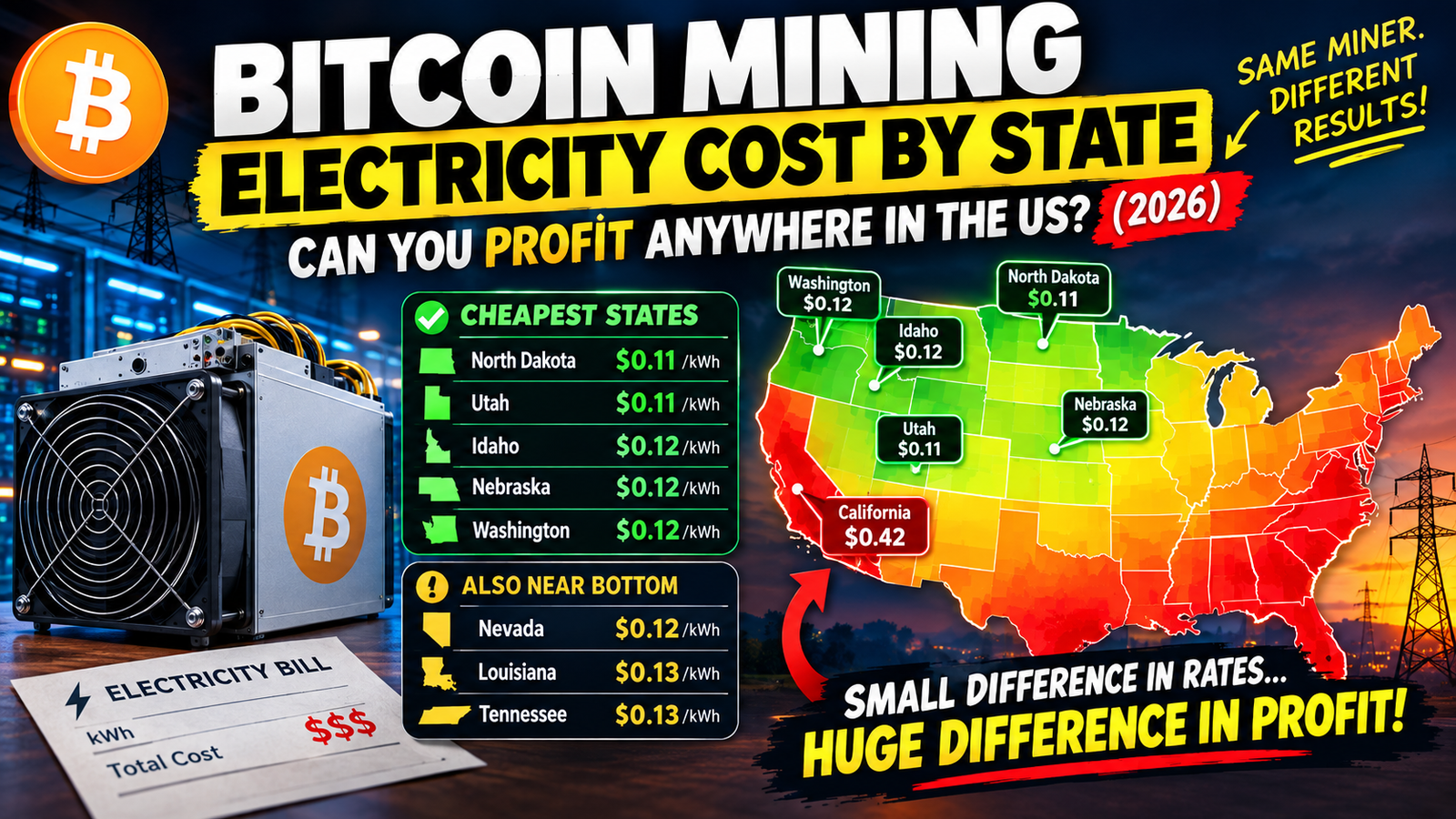
Meet two imaginary miners, Dana and Leo. They bought the exact same Bitcoin miner on the same day. Dana lives in North Dakota. Leo lives in California. A month later, Dana’s electric bill for that machine is a little under $300. Leo’s is over $850. Same hardware, same Bitcoin, completely different outcome.
(Dana and Leo aren’t real people, but the gap between their bills is very real.)
Today we’re looking at Bitcoin mining electricity costs by US state, because where you live might decide whether mining is a hobby, a hobby that costs you money, or something in between. Let’s dig in.
In This Guide
- The Short Answer
- What a Miner Pays in Different States
- The Cheapest States
- The Most Expensive States
- How to Find Your Real Rate
- Why Business Rates Matter
- Frequently Asked Questions
The Short Answer
No US state has cheap enough residential electricity to make home mining comfortably profitable right now. The cheapest states sit around 11 to 12 cents per kWh, which is close to break-even for a modern miner at Bitcoin prices near $80,000. Most states are well above that, and a few are extreme.
To keep the math simple, I’m using one example machine throughout: the Bitmain Antminer S21 (200 TH/s), which draws about 3,500 watts. That’s 84 kWh per day, or about 2,520 kWh per month. At recent network conditions it earns roughly $9.44 a day when Bitcoin is $80,000 (before pool fees). Here’s all the math you need: if your electricity costs more than about 11 cents per kWh, this machine loses money at $80,000 Bitcoin.
What a Miner Pays in Different States
Here’s what running that one S21 would cost at typical residential rates. The rates come from US Energy Information Administration averages reported in mid-2026. Sources round differently and rates move month to month, so treat these as close estimates.
| State | Approx. rate | Cost per day | Cost per month | Profit/day at $80K Bitcoin* |
|---|---|---|---|---|
| North Dakota | 11.3¢ | $9.49 | ~$285 | about break-even |
| Utah | 11.1¢ | $9.32 | ~$280 | about break-even |
| US average | 17.2¢ | $14.48 | ~$434 | -$5.04 |
| New York | 23.0¢ | $19.32 | ~$580 | -$9.88 |
| Massachusetts | 29.5¢ | $24.78 | ~$743 | -$15.34 |
| California | 34.3¢ | $28.78 | ~$863 | -$19.34 |
| Hawaii | 45.2¢ | $37.96 | ~$1,139 | -$28.52 |
*Illustrative: 200 TH/s at 3,500 W, about 0.000118 BTC/day, before pool fees and ignoring hardware cost.
The Cheapest States for Residential Power
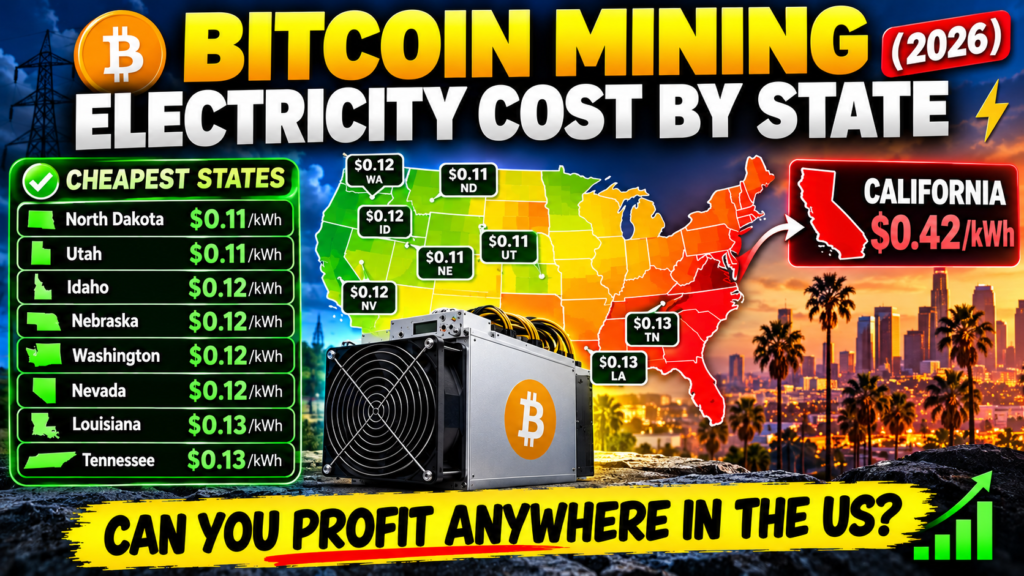
North Dakota, Utah, Idaho, Nebraska, and Washington all report residential rates in the 11 to 12 cent range in mid-2026 data. Depending on the source and month, Nevada, Louisiana, and Tennessee also show up near the bottom at around 12 to 13 cents.
Here’s the honest catch. Even the cheapest state leaves you right at the break-even line, with no room for a rough week in the market or a jump in network difficulty. Cheap power alone doesn’t make home mining a money machine.
The Most Expensive States
Hawaii leads by a mile at over 40 cents per kWh, with California next at around 32 to 34 cents. Connecticut, Massachusetts, and Rhode Island all sit near 28 to 30 cents. In those places, running a miner 24/7 costs several times what the coins are worth. If you live there and still want to learn mining, a small hobby device or a simple calculator exercise makes a lot more sense than a full-size machine.
How to Find Your Real Rate
A state average isn’t your rate. Here’s how to get the number that actually matters.
- Grab a recent electric bill. Divide the total amount by the kWh used. This includes delivery fees, which are part of what you really pay.
- Check your plan type. Some utilities charge more during peak hours, which matters a lot for a machine that runs all day.
- Look at tiers. In some areas, rates go up once you pass a usage level, and a miner can push you into the expensive tier.
- Compare to 11 cents. That’s roughly where an S21 breaks even at $80,000 Bitcoin. Use your own number to re-check at other prices.
For the official averages, the US Energy Information Administration publishes monthly data in its electricity price tables.
Why Business Rates Matter
This is the part most beginner articles skip. Commercial and industrial customers often pay much less than homeowners. In mid-2026 data, the lowest commercial rates were in North Dakota (about 7 cents), Oklahoma (about 8 cents), Utah (about 8 cents), and Texas (about 9 cents).
At Texas’s roughly 8.8 cents, that same S21 would cost about $7.39 a day to run, leaving around $2 of daily profit at $80,000 Bitcoin. That’s the difference between a hobby and a business, and it’s why large operators dominate mining. Hosting companies that offer space at industrial rates exist, but they come with contracts and fees, and scams love to imitate them. Before you send anyone money, read my guide on how to spot a fake Bitcoin mining app.
Frequently Asked Questions
Which US state is best for Bitcoin mining?
For home miners, states like North Dakota, Utah, and Idaho have the lowest residential rates. For business-scale mining, North Dakota, Oklahoma, Utah, and Texas show the lowest commercial rates.
How many kWh does a Bitcoin miner use?
An Antminer S21 (200 TH/s) draws about 3,500 watts, which is roughly 84 kWh a day or 2,520 kWh a month. That’s nearly three times what an average US household uses in a month.
Is mining profitable in California?
At residential rates around 32 to 34 cents per kWh, a full-size miner loses a large amount every day at recent Bitcoin prices. It isn’t a realistic money-making option there.
Do electricity rates change often?
Yes. Rates shift monthly and seasonally, and they’ve been trending upward. Check your latest bill, not a number from last year.
I want to hear from you! 💬 What state are you in, and what’s your rate per kWh? Tell me in the comments, and I’ll run your numbers with you. If this helped, share it with a friend who’s eyeing a miner, because it could save them a lot of money. See you in the next one! 🚀
Disclosure: Electricity rates come from US Energy Information Administration averages as reported by public sources in 2026, and differ slightly between sources and months. Profit figures are illustrative scenarios, not predictions. I have no affiliate relationship with any miner, seller, or hosting company mentioned. This article is for information only and is not financial advice.