
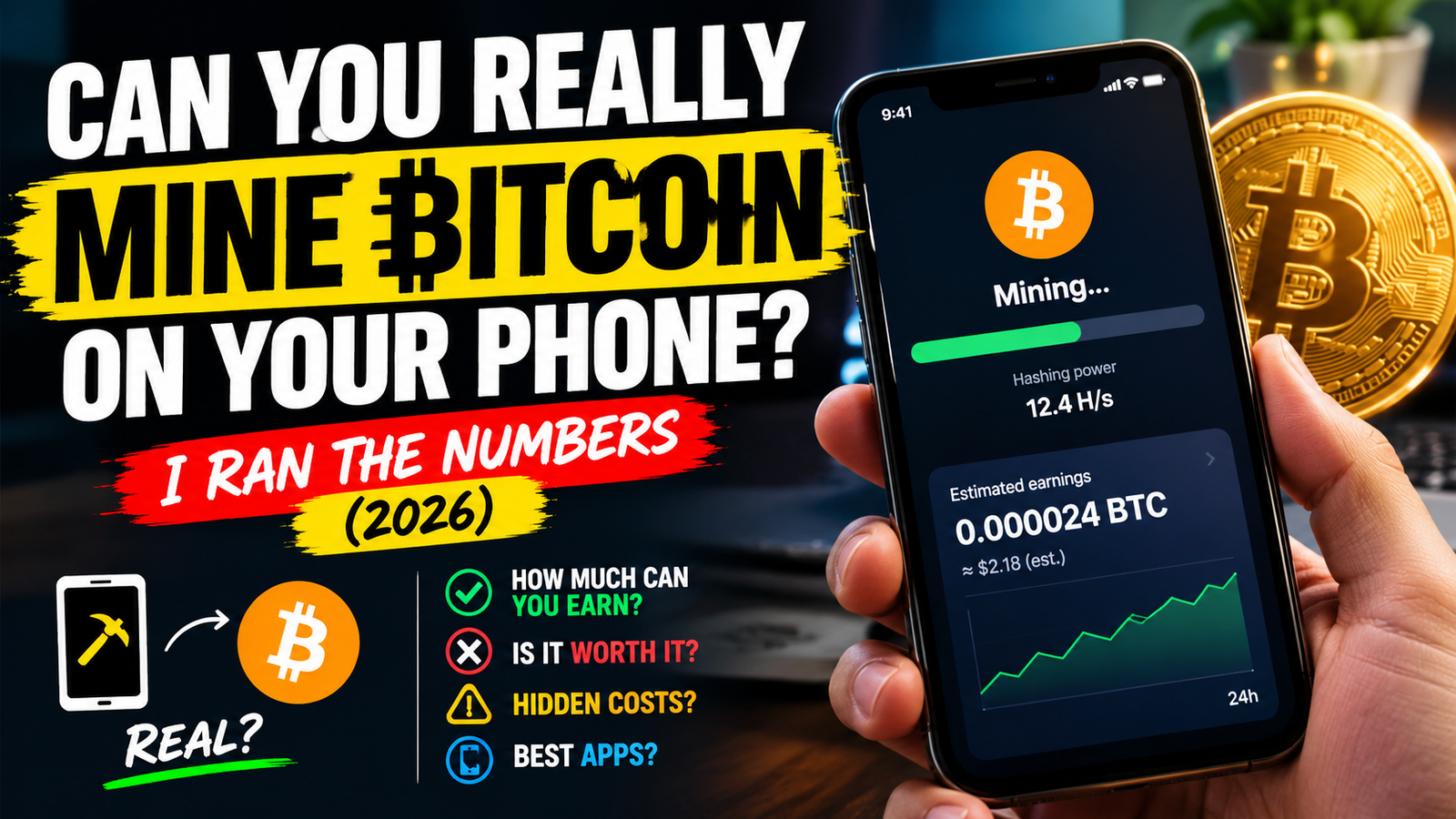
Picture this. It’s 11 p.m., and Maya is scrolling through her phone in bed. An ad pops up: “Mine Bitcoin from your phone. No experience needed. Free to start.” She taps. The app opens, a little dashboard lights up, and a number starts ticking upward. 0.00000021. 0.00000022. She watches it for five whole minutes, grinning like she just found a twenty in an old jacket.
Two weeks later, she’s tapped “upgrade” twice, and her balance still shows as “pending.” I’ll tell you how this story usually ends in a minute.
(Quick note: Maya isn’t a real person. She’s a composite of the stories that show up again and again in mining app reviews. But the pattern is very real.)
Hey friends, I’m glad you’re here. Today we’re answering one question honestly: can you really mine Bitcoin on your phone? I didn’t just repeat what other sites say. I ran the actual numbers, and they’re wild. Grab a coffee.
In This Guide
- The Short Answer
- I Ran the Numbers (This Part Shocked Me)
- The 3 Kinds of “Phone Mining” Apps
- Why These Apps Feel So Real
- What It Does to Your Phone
- What I’d Do Instead
- Before You Download Anything
- Frequently Asked Questions
The Short Answer
No. Not in any way that pays you. A phone can technically run mining software, but it will never earn Bitcoin in a way that’s worth your battery, let alone your time. And any app promising steady Bitcoin income from your phone is either doing something other than real mining or hiding where the mining happens.
I know, that’s not the answer the ad promised. So let me show you why, because once you see the math, you’ll never look at these apps the same way.
I Ran the Numbers (This Part Shocked Me)
Bitcoin mining is basically a giant guessing game. Machines around the world make trillions of guesses every second, hoping one of them lands on a winning answer. Whoever finds it gets the block reward, which is currently 3.125 BTC per block after the April 2024 halving.
Here’s how big that guessing game is. As of late August 2026, the whole network was making roughly 860 quintillion guesses per second (per ViaBTC’s hashrate guide). At that difficulty, finding one block takes about 540 sextillion guesses on average.
Now let’s give your phone a very generous shot. I’ll assume it can make 10 million guesses per second. That’s a friendly, rounded-up assumption for a modern phone, and I’m being kind here.
| Your phone (generous guess) | Bitcoin network (late Aug 2026) | |
|---|---|---|
| Guesses per second | about 10 million | about 860 quintillion |
| Time to find a block alone | about 1.7 billion years | about 10 minutes |
| Your share of all mining | about 0.000000000001% | 100% |
Okay, but what if you join a mining pool and share the work with thousands of people? Good question, and it’s where most apps say “see, it works!” Let’s check.
If your phone contributes 10 million guesses per second out of the network’s 860 quintillion, your slice of the daily block rewards (about 450 BTC a day, not counting fees) works out to roughly 0.0005 of a single satoshi per day. A satoshi is the smallest unit of Bitcoin, one hundred-millionth of a coin.
Translation: you’d need roughly five years of nonstop mining to earn one satoshi. And that’s before pool fees, and many pools have payout minimums you’d never reach. I did that math twice because I didn’t believe it the first time.
So when an app shows your balance climbing every second, that number isn’t coming from your phone’s mining. Which raises the real question: where is it coming from?
The 3 Kinds of “Phone Mining” Apps
After digging through listings and research, almost every app I’ve seen falls into one of three buckets.
1. Apps that really use your phone to mine
These exist, but they mostly target smaller coins and still don’t pay in any meaningful way. Reviewers of these apps warn they mostly just waste electricity and can wear out your device. Real, but pointless.
2. “Cloud mining” dashboards
Here your phone is just a screen. The app says the mining happens on remote hardware, and you watch the results. That’s a real business model, but it’s also the easiest one to fake, because you can’t see the hardware, the contracts, or where the money comes from. I broke one of these down in my Rise Miner review.
3. Reward apps dressed up as mining
This is the one that made me do a double take. One cloud-mining-style app I came across says, right on its own App Store page, that your “mining progress” actually represents participation in a rewards program where you earn by completing tasks sponsored by advertisers. In plain English: you’re watching ads, and the “mining” is a story wrapped around it.
The app didn’t hide it. It just put it where almost nobody reads. Which brings us to why this works so well.
Why These Apps Feel So Real
Back to Maya. Why did she keep going? Because these apps are designed the way slot machines are designed.
- The number keeps ticking. A balance that grows every second gives your brain a steady little reward.
- The first taste feels good. Some apps let you reach a small balance quickly, so you feel like it’s working.
- The upgrade pitch comes at the right moment. Just when progress slows, you’re offered a “power boost.”
- The exit is always just out of reach. Minimum withdrawals, pending payouts, or one more step before you can cash out.
Here’s my honest advice, friend to friend: if you notice yourself thinking “I’ve already put in so much, I should keep going,” that’s your cue to stop. That feeling is exactly what these designs are built to create. It doesn’t mean you’re gullible. It means the design works on everybody.
What It Does to Your Phone
Even if you don’t care about the earnings, there’s a cost you’ll feel right away. Running mining software keeps your phone’s processor working hard. Reviewers and exchange guides consistently warn that this causes heat, fast battery drain, slower performance, and possible long-term wear on the hardware.
So the trade looks like this: you spend battery life and hardware lifespan to earn something that rounds to zero. That’s a bad deal every time.
What I’d Do Instead
If you just wanted to get into crypto, good news: you don’t need a mining app for that. Here are three honest routes, depending on what you’re really after.
If you want to own some Bitcoin
Buy a small amount on a regulated exchange in your country, like Coinbase, Kraken, or Gemini in the US (check that any platform supports your state first). Start with an amount you’d be fine losing, because prices swing hard and nobody can promise a profit.
If you’re curious about how mining works
Some hobbyists run tiny solo miners at home for fun. It’s closer to buying a lottery ticket with cool hardware than earning a paycheck, and the odds of finding a block are extremely small. If that sounds fun, go for it as a hobby, not as income.
If you just want to learn
Some reputable exchanges offer learn-and-earn programs where you watch short lessons and take quizzes for small amounts of crypto. The rewards are small, but they’re real, and you learn something. Always check the platform is licensed where you live.
Before You Download Anything
Whatever you decide, run every mining app through these five questions. It takes about a minute. For the full checklist, read my guide on how to spot a fake Bitcoin mining app.
- Does it promise steady or guaranteed income? That’s a red flag.
- Who runs it? Look for a real company with a consistent name everywhere.
- Is there a fee to withdraw? A real payout never requires you to send money first.
- What do the terms say? Search for “game,” “simulation,” or “rewards program.”
- What do the one-star reviews say? Search “[app name] withdrawal” before you install.
Frequently Asked Questions
Can you mine Bitcoin on an Android phone or iPhone?
You can run mining software on either, but neither will earn meaningful Bitcoin. The math above applies to any phone, and iPhones and Androids are far too slow to compete with specialized mining machines.
How long would it take to mine 1 Bitcoin on a phone?
Using the generous numbers above, a phone would earn about half of one-thousandth of a satoshi per day. One full Bitcoin is 100 million satoshis, so in practical terms, you’d never get there in your lifetime.
Does joining a mining pool fix the problem?
Pools let small miners share rewards, but your share is still proportional to your computing power. A phone’s slice is so tiny that it’s worth almost nothing, and many pools also have minimum payouts.
Are all phone mining apps scams?
Not all of them are built to steal, but many are misleading. Some are ad-driven reward apps, some are cloud mining dashboards you can’t verify, and a few simply waste your battery. Treat any promise of easy income with heavy skepticism.
Is cloud mining on my phone legit?
Real cloud mining exists, but the phone is only a dashboard. A trustworthy provider is open about who owns the hardware, what your contract costs, and what risks you’re taking. If an app is vague about all of that and heavy on promises, walk away.
So how does Maya’s story end? She did what I’d hope any of us would do. She stopped tapping “upgrade,” checked the reviews, and kept her money. She still owns a tiny bit of real Bitcoin she bought through a regulated exchange, and she sleeps fine.
Now I want to hear from you! 💬 Have you tried a phone mining app? Did it pay out, or did it leave you with a “pending” balance like Maya’s? Tell me your story in the comments, because it might save someone else from an expensive lesson. And if this helped, send it to a friend who keeps seeing those “mine Bitcoin on your phone” ads. See you in the next one! 🚀
Disclosure: Network figures are from public data as of late August 2026, and the phone figure is a generous round-number estimate for illustration, not a measured benchmark. I have no affiliate relationship with any app or exchange mentioned. This article is for information only and is not financial advice.