
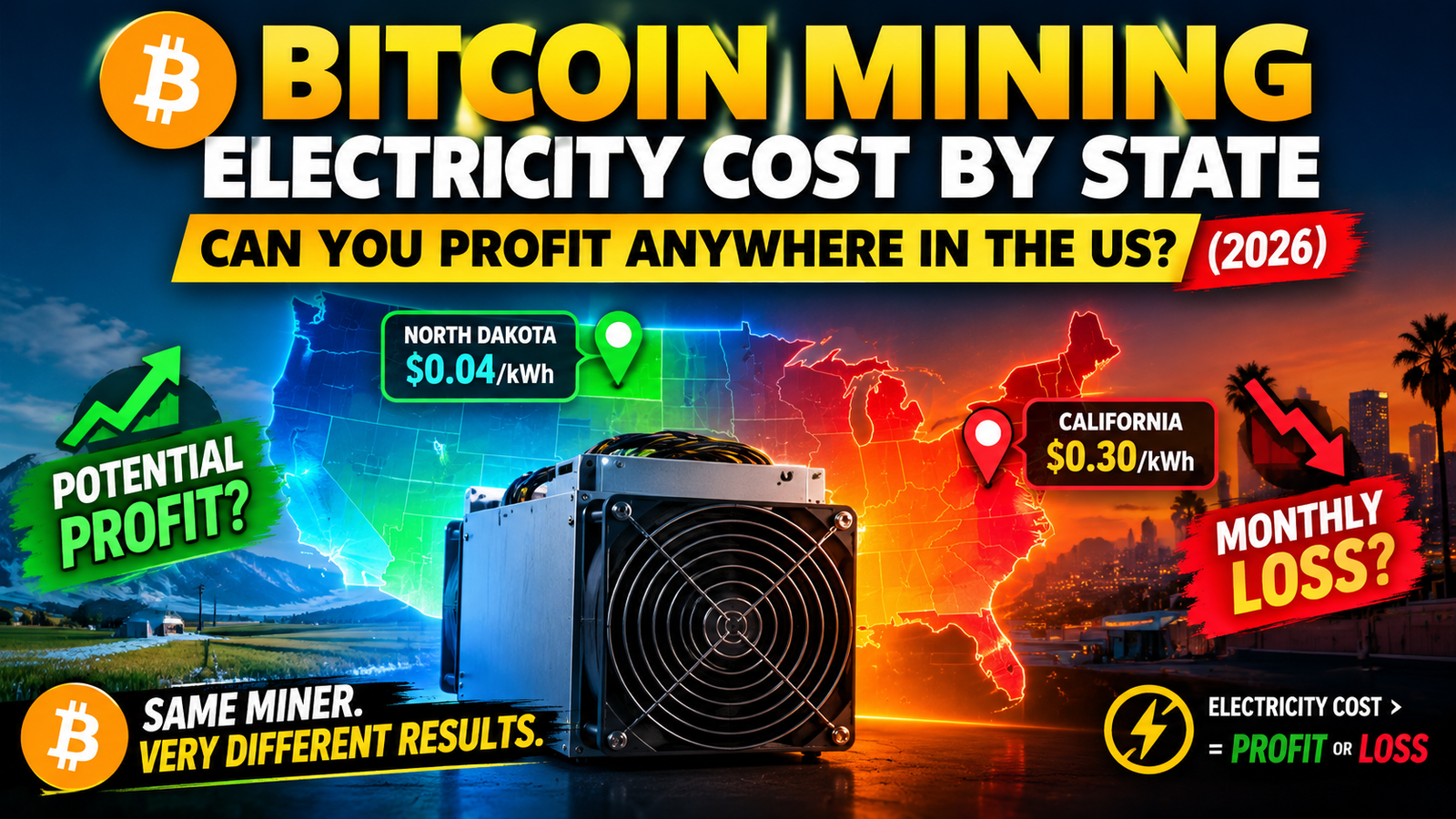
Here’s a question I think about a lot: if two people buy the exact same Bitcoin miner, and one lives in North Dakota and the other in California, who comes out ahead? The surprising answer is that the miner is identical. The outcome isn’t, and the difference is so big it can flip a small profit into a monthly loss of hundreds of dollars. 👋 Today we’re looking at where in the US you’d even have a chance, state by state. I’ll show you the numbers, the pattern, and the one rule that matters more than any machine spec. Let’s dig in.
👋 Today we’re looking at where in the US you’d even have a chance, state by state. I’ll show you the numbers, the pattern, and the one rule that matters more than any machine spec. Let’s dig in.
In This Guide
- The One Rule That Matters
- Electricity Rates Across the US
- What an Antminer S21 Does at Each Rate
- Do the Cheapest States Work?
- How Real Miners Get Cheaper Power
- How to Find Your Real Rate
- Frequently Asked Questions
The One Rule That Matters
For a modern miner like the Bitmain Antminer S21 (about 200 TH/s at roughly 3,500 watts), the break-even electricity price at Bitcoin near $80,000 is about 10 cents per kilowatt-hour. Pay less than that and you profit. Pay more and you lose money every day the machine runs. I walk through that math in my guide on whether Bitcoin mining is still profitable in 2026.

Electricity Rates Across the US
According to US Energy Information Administration (EIA) data reported in spring and summer 2026, the national average residential rate is about 18.83 cents per kWh, and it has risen about 25% in four years. Here’s the spread:
- Cheapest end: roughly 11 to 12 cents. North Dakota, Utah, Idaho, Washington, and Nebraska show up here, with the exact order shifting month to month.
- Middle: around the 18 to 19 cent national average.
- Expensive: New York, Massachusetts, and Connecticut sit near 29 to 30 cents. California is around 34 cents.
- Most expensive: Hawaii, at roughly 42 to 47 cents depending on the month.
Sources report slightly different numbers by month, so treat these as ranges and check the current figures on the EIA’s electricity data page or your own bill.
What an Antminer S21 Does at Each Rate
An S21 runs about 84 kWh per day (3.5 kW × 24 hours) and earns roughly $8.40 a day in Bitcoin rewards at today’s network size and an $80,000 Bitcoin. Here’s what happens at each price tier:
| Example rate | Where you might see it | Daily power cost | Daily result | Monthly result |
|---|---|---|---|---|
| 6¢ | Industrial or wholesale power | about $5.04 | +$3.36 | about +$100 |
| 11.5¢ | Cheapest residential states | about $9.66 | -$1.26 | about -$38 |
| 13.5¢ | Average US commercial rate | about $11.34 | -$2.94 | about -$88 |
| 18.83¢ | US residential average | about $15.82 | -$7.42 | about -$223 |
| 29.5¢ | New York, Massachusetts, Connecticut | about $24.78 | -$16.38 | about -$491 |
| 34¢ | California | about $28.56 | -$20.16 | about -$605 |
| 46.6¢ | Hawaii | about $39.14 | -$30.74 | about -$922 |
These are estimates that ignore pool fees and transaction-fee income, and they change with Bitcoin’s price and network size. But the pattern doesn’t change: at residential rates, every state loses money with this machine. The only question is how much.
Do the Cheapest States Work?
Close, but not quite. Even at 11.5 cents, the S21 is slightly underwater at today’s numbers. The cheap states put you near break-even, so a small change, like Bitcoin’s price rising 15% or the network shrinking, could push you into profit. But a drop would push you right back out.
That fragility is why I’d never describe any residential location as “the best state to mine.” A better description is “the least bad.”
How Real Miners Get Cheaper Power
- Industrial rates and special contracts with utilities, often far below residential prices.
- Hosting facilities. You own the machine, but a facility with cheap power runs it for a fee. Industry analysts note that hosted mining often beats home mining on power rate, uptime, and repairs.
- Surplus or stranded power, like energy that would otherwise be wasted.
Notice what’s missing from that list: “a regular house in a cheap state.” If you’re a beginner, the first question isn’t “which state?” It’s “can I get a rate below about 8 cents at all?” For most people, the honest answer is no.
How to Find Your Real Rate
- Open a recent electric bill and note the total cost and total kWh used.
- Divide total cost by kWh. This captures delivery fees and surcharges that the “supply rate” alone misses.
- Check whether your utility has time-of-use pricing, since running a miner during peak hours can cost far more.
- Remember that a miner this size adds about 2,500 kWh a month, and some utilities charge higher rates above certain usage tiers.
Curious what that extra usage does to a monthly bill? I break it down in what home mining really does to your electric bill.
Frequently Asked Questions
Which US state is best for Bitcoin mining?
States with the lowest residential rates, such as North Dakota, Utah, Idaho, Washington, and Nebraska, come closest to break-even. But at today’s numbers, even they are around the line, not comfortably above it.
Can I mine Bitcoin profitably in California or New York?
At residential rates, no. With rates around 29 to 34 cents per kWh, a modern miner loses hundreds of dollars a month.
What if I have solar panels?
Surplus solar that you can’t sell back at a good rate can lower your effective cost a lot. But panels have their own cost, and running a miner on power you could have sold changes the math, so count that opportunity cost honestly.
Are electricity rates going up?
EIA data shows residential rates rose about 7% between April 2025 and April 2026, and the agency expected further increases in 2026. Rising rates push break-even further away.
Let’s make this personal: drop your state and your rate per kWh in the comments, and I’ll tell you where you’d land on the table above. Know someone who’s shopping for a miner? Send them this first. Where you plug in matters more than what you buy. 🗺️
Disclosure: Electricity figures come from EIA data as reported by third-party sources in April to June 2026 and vary by month. Mining results assume Bitcoin near $80,000 and a network of about 860 EH/s. Check current numbers and your own utility bill before making decisions. I have no affiliate relationship with any miner or utility mentioned. This article is for information only and is not financial advice.