

Search “is Bitcoin mining profitable” and you’ll get two kinds of answers. Half the internet says “absolutely, here’s a miner to buy.” The other half says “never, don’t bother.” Both are lazy. The truth is more interesting: mining can be profitable, but only for a very specific kind of person with a very specific kind of power bill.
Hey, welcome back to Cryptokashyap.com 👋 Today I’m not going to hand you a verdict. I’m going to hand you a calculator, walk you through a real example with current numbers, and let you decide whether your situation passes the test. Grab a coffee.
In This Guide
- The Short Answer
- The 3 Numbers That Decide Everything
- A Worked Example With an Antminer S21
- What Changed in 2026
- Who Still Makes Money
- Your 5-Minute Worksheet
- What Could Change the Answer
- Frequently Asked Questions
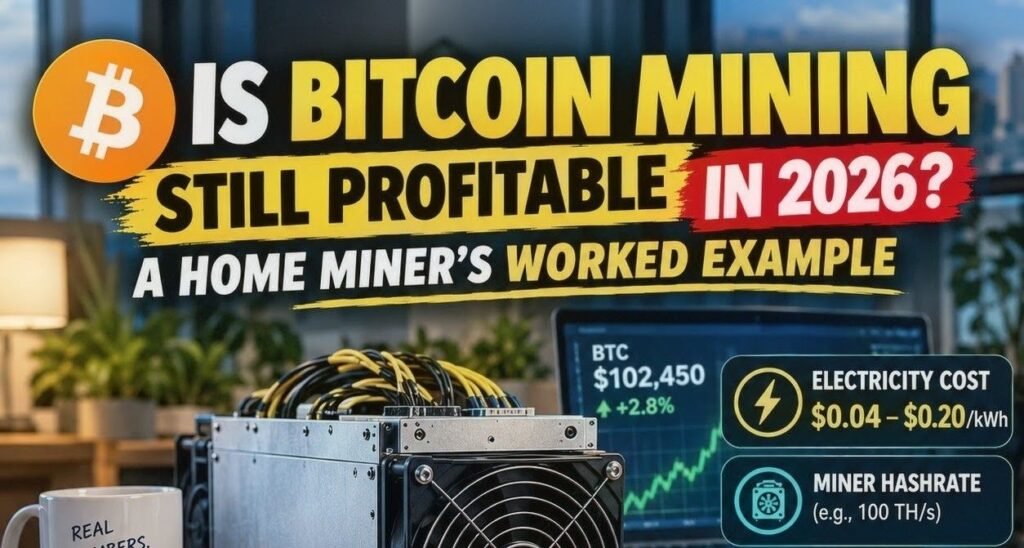
The Short Answer
At normal US home electricity prices, Bitcoin mining loses money in 2026. It can still make money for operators with efficient machines and cheap, industrial-style power. Industry analysts put the rough line at around 8 cents per kilowatt-hour (kWh) for modern machines. The average American pays about 18.8 cents.
That gap is the whole story. Let me show you the math so you can check it yourself.
The 3 Numbers That Decide Everything
- What the network pays per unit of computing power. Miners call this “hashprice.” It depends on Bitcoin’s price, how much total mining power is online, and the block reward, which is 3.125 BTC per block since the April 2024 halving.
- Your machine’s efficiency. Measured in joules per terahash (J/TH). Lower is better. A 15 J/TH machine uses roughly half the electricity of a 30 J/TH machine for the same output.
- Your electricity price. This is the one most beginners underestimate, and it’s the one that usually kills the deal.
A Worked Example With an Antminer S21
Let’s use a popular modern machine, the Bitmain Antminer S21. It’s rated at about 200 TH/s and roughly 3,500 watts, which works out to about 17.5 J/TH. I’ll assume Bitcoin is around $80,000, which is close to where it traded in early September 2026. Plug in the live price when you do your own version.
The Bitcoin network was estimated at about 860 EH/s in late August 2026 (ViaBTC’s hashrate guide). Your S21’s share of that is about 0.000023%. The network hands out roughly 450 BTC per day in block rewards.
| Daily Bitcoin earned (rewards only) | about 0.000105 BTC |
| Daily revenue at $80,000 BTC | about $8.40 |
| Daily electricity used | 3.5 kW × 24 hours = 84 kWh |
| Daily power cost at 8¢/kWh | about $6.72 (profit of roughly $1.70 a day) |
| Daily power cost at 18.83¢/kWh (US average) | about $15.82 (loss of roughly $7.40 a day) |
| Break-even electricity price | about 10¢/kWh |
Notice what that table says. The same machine makes a small profit in one house and loses over $200 a month in another. The machine isn’t the variable. The power bill is. (These figures ignore pool fees and transaction-fee income, which roughly offset each other in small amounts, so treat them as a solid estimate, not an exact quote.)
What Changed in 2026
Here’s the part most evergreen articles miss. Network hashrate touched new highs above 1 zettahash per second in January 2026, then was estimated near 1.08 ZH/s in April. By late August, it was down to about 860 EH/s. That’s a drop of roughly a fifth. Analysts attribute part of it to a squeeze on miner margins: the money earned per unit of computing power (hashprice) fell sharply in the first half of the year, and at least one public miner stopped mining Bitcoin entirely in June.
Why does that matter to you? Because when less power competes, each machine earns a bit more, which is why the numbers above aren’t worse. But it also tells you something important: even professional miners with cheap power and huge scale are feeling the squeeze. A beginner with a spare outlet is not getting a better deal than they are.
Who Still Makes Money
- Industrial operators paying low wholesale electricity rates, often well below 8 cents.
- People with near-free power, such as surplus solar they can’t sell back to the grid at a good rate.
- Hobbyists who value the heat. Every watt a miner uses turns into heat, so in a cold climate where your alternative heating is expensive, a miner can partly pay for itself as a heater. That’s a heating decision with a Bitcoin bonus, not a profit plan.
Your 5-Minute Worksheet
- Find your real electricity rate in cents per kWh on your utility bill, including delivery charges.
- Look up your machine’s hashrate and wattage. Use the maker’s spec sheet.
- Pull today’s numbers: Bitcoin price and network hashrate.
- Daily revenue = (your hashrate ÷ network hashrate) × 450 BTC × Bitcoin price.
- Daily power cost = kilowatts × 24 × your rate.
- Revenue minus power cost is your daily margin. Then divide the machine’s price by that margin to see how long payback would take. If the margin is negative, payback is never.
Want a shortcut? Break-even rate in cents = daily revenue ÷ (kilowatts × 24) × 100. If your rate is above that, you lose money.
What Could Change the Answer
- Bitcoin’s price. A higher price lifts revenue instantly. A lower one can wipe out thin margins just as fast.
- Difficulty and hashrate. More miners joining means each machine earns less.
- The next halving, expected around 2028, which will cut the block reward in half again.
- Machine prices. New models get cheaper and more efficient, which can make last year’s machine obsolete.
And one honest caution: don’t buy a miner because Bitcoin “might go up.” That’s a bet on price, and you can place that bet far more cheaply by buying Bitcoin directly. More on that in my guide comparing mining vs buying Bitcoin.
Frequently Asked Questions
Is Bitcoin mining still profitable in 2026?
For most people mining at home on normal electricity rates, no. It can be profitable with efficient machines and electricity under roughly 8 to 10 cents per kWh.
What electricity price do I need to make a profit?
For a modern 17.5 J/TH machine at Bitcoin near $80,000, break-even is around 10 cents per kWh. Lower is better, and the margin disappears fast if Bitcoin’s price falls.
Is it better to mine or just buy Bitcoin?
At typical home electricity prices, buying gets you far more Bitcoin for the same money. Mining can make sense only for hobbyists, people with very cheap power, or those who want the heat.
Can a cheaper, older miner make money?
Rarely. Older machines use more electricity per terahash, so they need even cheaper power to clear a profit.
Your turn: grab your last electric bill, work out your rate, and run the worksheet above. Then tell me the result in the comments, and I’ll help you sanity-check it. If this saved you from a costly impulse buy, pass it to a friend who’s eyeing a miner. Run the numbers before the machine runs you. 🧮
Disclosure: Figures are estimates based on public data from August and September 2026 and assume Bitcoin near $80,000. Check live prices and your own utility rate before making decisions. I have no affiliate relationship with any miner, pool, or exchange mentioned. This article is for information only and is not financial advice.