
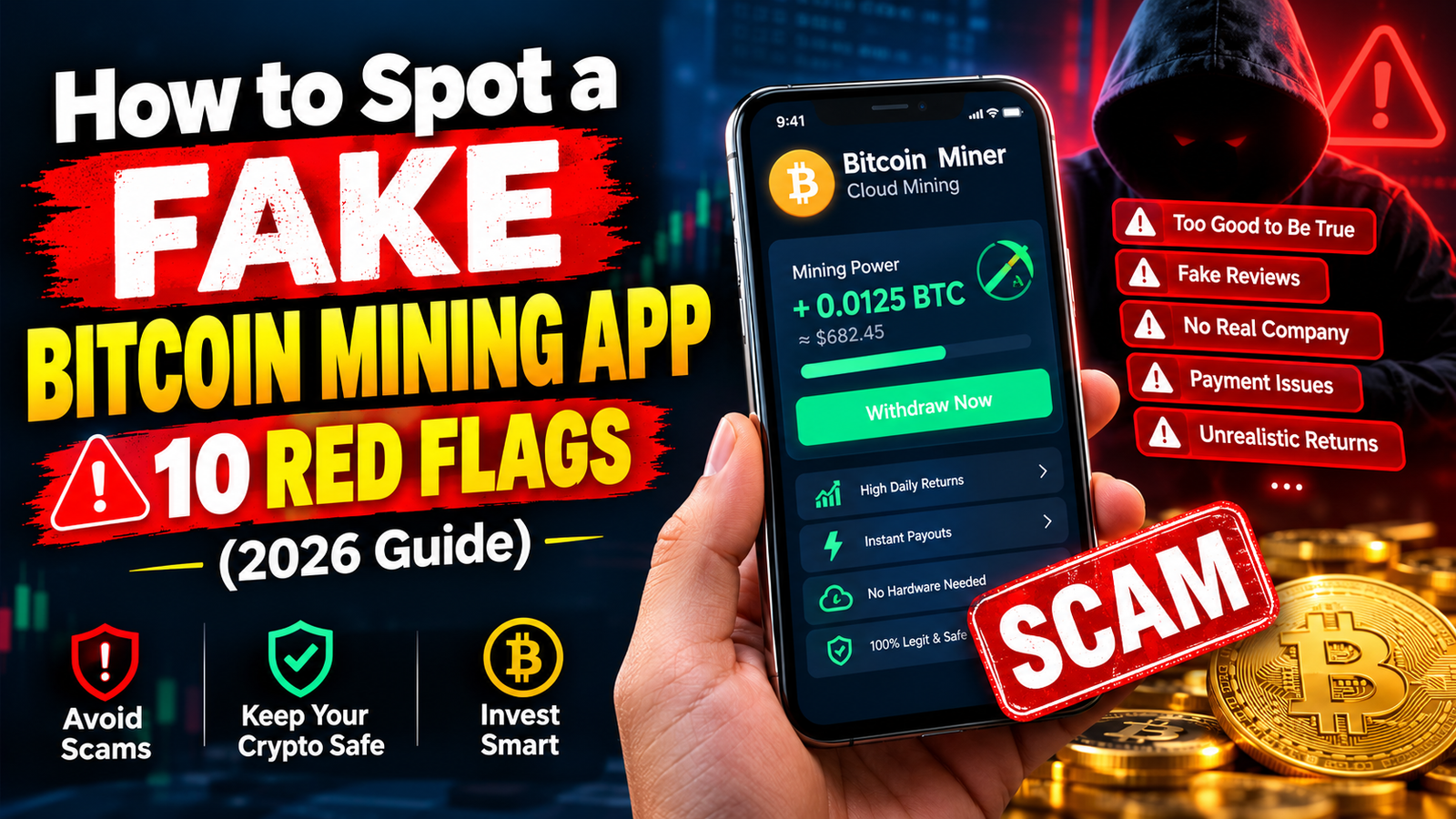
Hey friends, welcome back to Crypto Honest Reviews! 👋 Today’s topic comes straight from your messages: how do you tell a real Bitcoin mining app from a fake one? There are a lot of apps out there promising easy Bitcoin, and some of them are honest about what they are. Many are not. Let’s walk through the red flags together so you can protect your money.
Quick note: this guide is for information only and isn’t financial advice. Every red flag below is a warning sign, not proof on its own. The more of them you spot in one app, the more careful you should be.
In This Guide
- How Fake Mining Apps Actually Make Money
- The 10 Red Flags
- A 5-Minute Safety Check
- What Real Cloud Mining Looks Like
- What to Do If You Already Got Caught
- Frequently Asked Questions
How Fake Mining Apps Actually Make Money
Here’s the thing most people don’t realize: a fake mining app doesn’t need to steal from you directly. Security researchers have found apps that do no real mining at all. Instead, they show a growing balance on your screen and earn money through ads, subscriptions, upgrade purchases, or by collecting your data. The balance you see is just a number, and when you try to withdraw it, that’s where things fall apart.
Some apps are even upfront about it if you read the fine print. Researchers have found finance-category apps whose own terms of use say the app is a game with no real crypto mining inside. Most people never scroll that far, and that’s what these apps count on.
The 10 Red Flags
1. It promises guaranteed or huge returns
Real mining profits depend on Bitcoin’s price, network difficulty, and electricity costs, and all of those change. Anyone promising fixed daily returns, or a huge monthly percentage, is telling you something that can’t be true.
2. It says your phone or laptop mines Bitcoin profitably
Bitcoin mining today runs on specialized machines called ASICs. An ordinary phone or laptop can’t earn meaningful Bitcoin, and an app that claims otherwise isn’t doing real mining on your device. (Some apps say the mining happens on remote hardware instead, which brings us to the next flags.)
3. You have to pay a fee to withdraw
This is one of the oldest tricks in the book. You “earn” some Bitcoin, then you’re told you need to pay a tax, an activation fee, or a conversion fee before you can cash out. Real platforms take fees out of your balance. They don’t ask you to send more money first.
4. Nobody can tell you who runs it
Look up the developer. Is there a real company with a website, named people, and a consistent name across the app store, the privacy policy, and its support pages? If the company name keeps changing, or the only contact is a free email address, be careful.
5. The terms of use say “entertainment” or “simulation”
Always read the terms, or at least search them for words like “game,” “simulation,” “virtual,” or “entertainment.” If the fine print says no real mining happens, the balance on your screen is just for show.
6. Ads everywhere, or “watch ads to mine”
If the app makes you watch video ads to start or speed up mining, you’re probably the product. The ads are how the app earns money, whether or not any Bitcoin ever reaches you.
7. Your balance grows, but you can never withdraw
Watch out for very high minimum withdrawals that you’d need months to reach, withdrawals that stay “pending,” or upgrades you must buy before you’re allowed to cash out. A balance you can’t withdraw isn’t really yours.
8. The reviews tell two different stories
Don’t just look at the star rating. Sort by the lowest reviews and look for patterns like “never received my withdrawal” or “support disappeared.” Be wary of piles of short, similar five-star reviews that all sound the same.
9. It wants more data than it needs
Check the data safety or privacy section. A mining dashboard has no reason to collect your location or financial information and share it with third parties. If you can’t delete your data either, that’s a bigger warning sign.
10. Pressure, urgency, and surprise messages
Countdown timers on upgrades, “limited-time” power boosts, and heavy referral pushes are all pressure tactics. So are out-of-the-blue emails or messages saying you’ve got a huge Bitcoin balance waiting, usually with a PDF or link to “collect” it. Those are known phishing scams. Don’t click anything, and don’t enter wallet details.
A 5-Minute Safety Check
- Search “[app name] withdrawal” and “[app name] scam.” Read what real users are saying.
- Look up the developer. Check that the company name matches everywhere.
- Read the terms of use for words like “game” or “simulation.”
- Check the data safety section before installing.
- Test with nothing first. If you try the app, don’t deposit money until a small withdrawal actually reaches your wallet or account.
Want to see this checklist in action? Here’s how I applied it to a popular app in my Rise Miner review.
What Real Cloud Mining Looks Like
Real cloud mining does exist, but it looks very different from a free app that pays you for opening it. A legitimate provider is usually open about who owns it, where its hardware is, what your contract costs, and how long it lasts. It explains the risks, including that profits can be low or even negative when Bitcoin’s price drops or mining gets harder. If a company is vague about all of that and heavy on promises, that’s your cue to walk away.
What to Do If You Already Got Caught
First, don’t beat yourself up. These apps are designed to look convincing, and lots of smart people get fooled. Here’s what to do next:
- Stop sending money, including “fees” to unlock your balance.
- Contact your bank or card company about disputing the charges.
- Report the app to the app store you got it from.
- If you’re in the US, file a report at ReportFraud.ftc.gov. Elsewhere, report it to your country’s consumer or financial regulator.
- Beware of “recovery” services. Anyone who contacts you offering to get your crypto back for a fee is very likely running a second scam.
- Change passwords if you entered any login or wallet details anywhere.
Frequently Asked Questions
Can you really mine Bitcoin on your phone?
Not profitably. Bitcoin mining needs specialized hardware, so a phone can’t earn meaningful amounts. Apps that seem to pay you are either showing numbers that can’t be withdrawn or using remote hardware you can’t verify.
Are all Bitcoin mining apps scams?
Not necessarily, but many are misleading, and it’s hard for regular users to tell the difference. That’s why I suggest treating any app that promises easy income with heavy skepticism and using the safety check above.
Is a high Play Store rating a sign an app is safe?
No. Ratings can be inflated, and a high average can hide serious complaints. Always read the low-star reviews and search outside the app store too.
What’s a safer way to get into crypto?
Many beginners choose to buy real crypto on a licensed exchange in their country instead, though prices swing a lot and you can lose money. Only use money you can afford to lose, and check that any platform is regulated where you live.
Now I’d love to hear from you! 💬 Have you run into a mining app that turned out to be fake? Tell me what happened in the comments below, because your story could stop someone else from losing money. And if this guide helped, please share it with a friend who’s curious about crypto. See you in the next one! 🚀
Disclosure: This guide is based on public security research and general scam-awareness information, and I have no affiliate relationship with any app mentioned. It is for information only and is not financial advice.